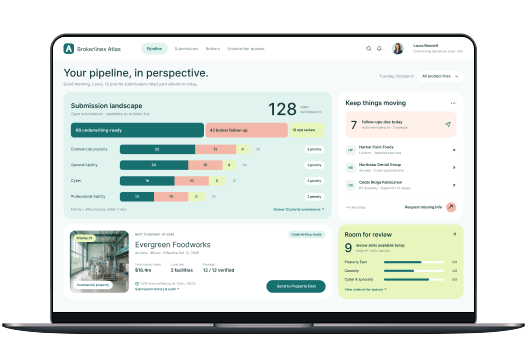
The client is a U.S.-based specialty and commercial insurance organization working through brokers and internal underwriting teams across multiple product lines. Brokerlines Atlas provided underwriting submission software that consolidated questionnaires, supporting documents, risk details, and submission status into a single, structured process.
The insurance submission management software combined document collection, risk-data extraction, completeness checks, task creation, underwriting queues, and pipeline reporting. Complete submissions reached underwriters with clearer risk information and fewer manual preparation steps.
Across selected workflows, manual submission preparation decreased by 26%, time to prepare underwriter-ready submissions by 34%, and routing time to underwriting queues by 35%.
The client is a U.S. specialty and commercial insurer working with brokers and internal underwriting teams across multiple product lines.
Each submission can include policy information, risk documents, pricing inputs, supporting records, and broker communications. These materials must be reviewed and structured before an underwriter can evaluate the risk.
The organization’s insurance underwriting software operated alongside CRM, policy administration, document management, and broker communication systems supporting different parts of the submission lifecycle.
Consistent risk information and clear submission status were therefore essential to keeping underwriting teams focused on assessment and decision-making.
Broker submissions arrived in different formats and often contained missing, duplicated, or inconsistently structured information. Underwriters spent time checking documents, extracting risk details, and following up with brokers before substantive risk assessment could begin.
The insurer needed broker submission automation to reduce repetitive preparation and create a more consistent path from broker intake to underwriter review.
An underwriting workbench was also required to give underwriting teams a consolidated view of submission status, priorities, missing information, and pending actions.
The scope required insurance software development capable of connecting the new workflow with existing CRM, policy administration, and document management systems.
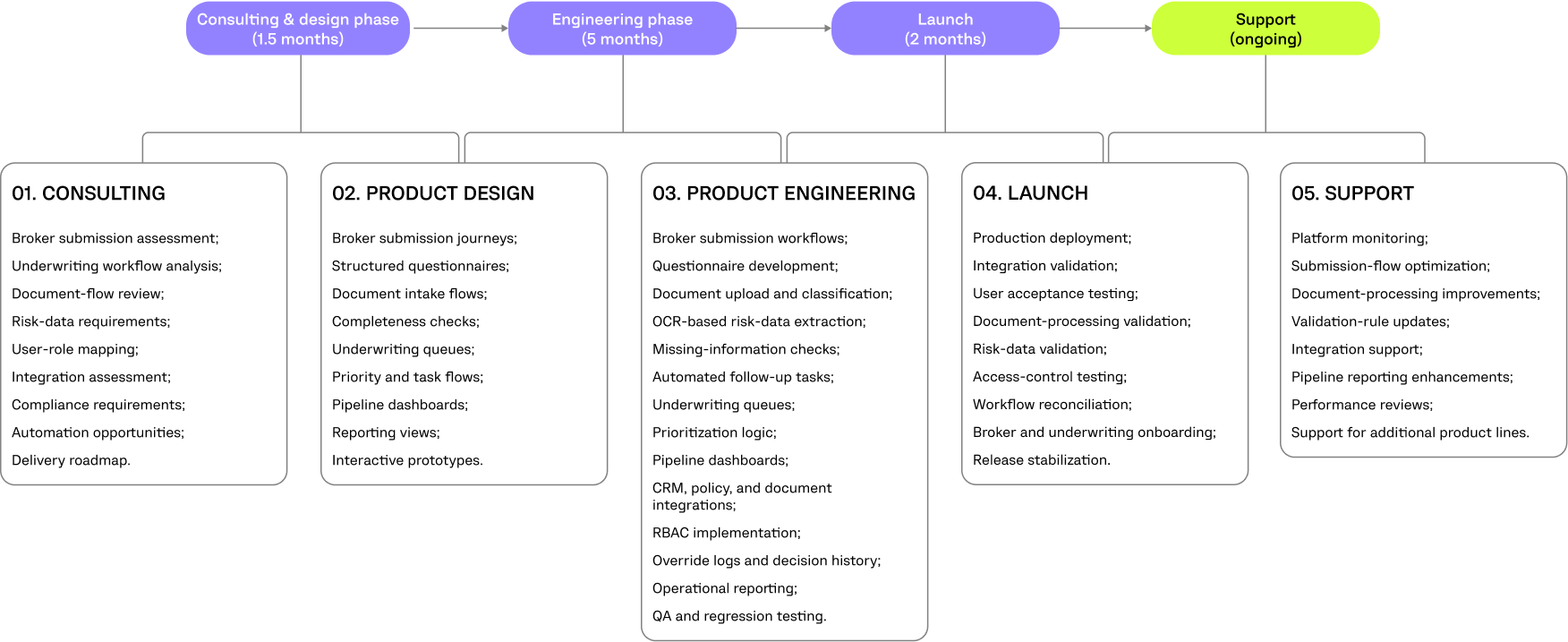
Computools mapped broker submission flows, underwriting queues, document requirements, and existing policy administration dependencies before designing a structured journey for brokers and underwriting teams.
The platform used underwriting workflow automation to move submissions through intake, validation, follow-up, prioritization, and assignment. Rules identified missing information and generated the required follow-up tasks before underwriter review.
A structured insurance document intake process brought risk documents and supporting materials into the relevant submission record, reducing manual consolidation across channels.
The broker portal guided brokers through questionnaires, document collection, and outstanding information requirements while exposing submission status throughout the process.
OCR and AI-supported insurance risk data extraction, converting information from uploaded documents into structured risk parameters that could be validated before assessment.
The resulting insurance submission intake process connected broker-provided data with underwriting queues, pipeline dashboards, decision history, override logs, and existing insurance systems.
Brokerlines Atlas reduced administrative preparation before risk assessment and improved the consistency of submissions reaching underwriting teams:
Role-specific interfaces created through web development gave brokers and underwriting teams clearer visibility into submission status, missing information, priorities, and pending actions.
To keep risk information consistent across connected systems, the team used data engineering to align structured submission data with CRM, policy administration, and document records. This improved the reliability of underwriting preparation and pipeline reporting.
Document-heavy submissions also benefited from targeted AI development for classification, risk-data extraction, and information validation. Underwriters retained final control over pricing, eligibility, and approvals.
Submission history, override logs, and role-based access strengthened auditability and made changes easier to trace throughout the underwriting preparation process.
The engagement required coordinated expertise across underwriting operations, broker-facing UX, document processing, structured risk data, and legacy insurance integrations.
Computools brought these disciplines into one delivery team, allowing business rules, data requirements, and integration dependencies to be validated together before implementation.
This reduced ambiguity across broker and underwriter workflows and gave the insurer a controlled path for expanding automation while preserving existing underwriting authority.

The design focused on helping brokers submit complete information and giving underwriting teams a clear view of risk data, readiness, priority, and pending actions.
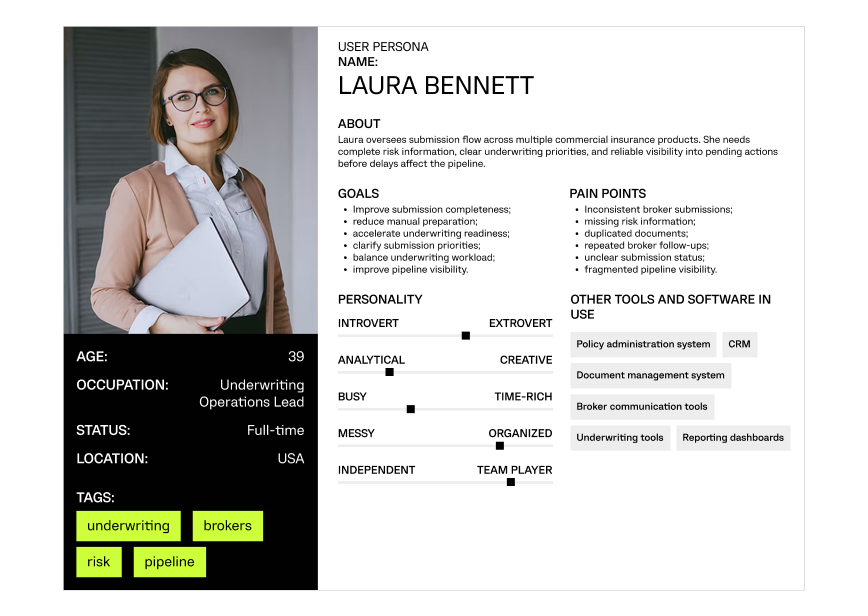
Defining the needs of an underwriting operations leader responsible for submission quality, pipeline visibility, and workload distribution.
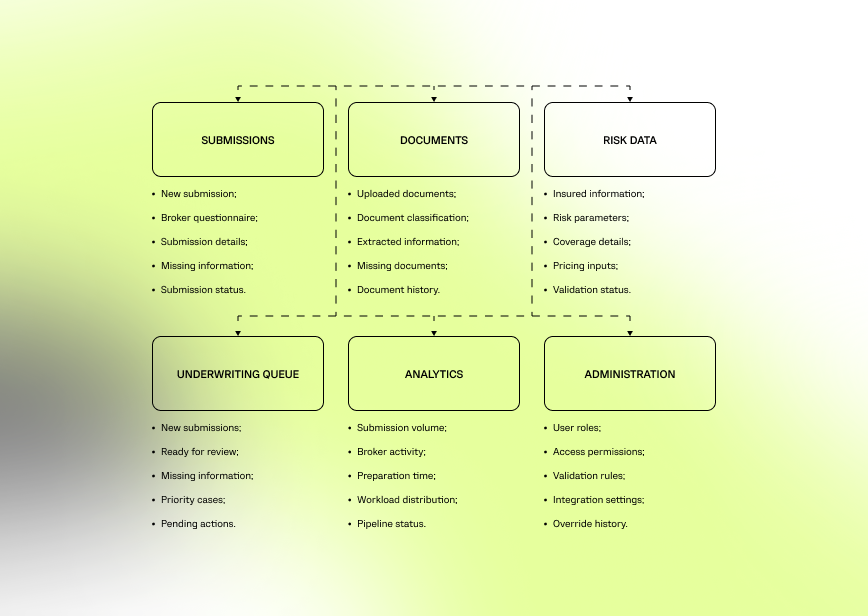
Organizing broker intake, documents, risk information, underwriting queues, pipeline reporting, and administration around the submission lifecycle.
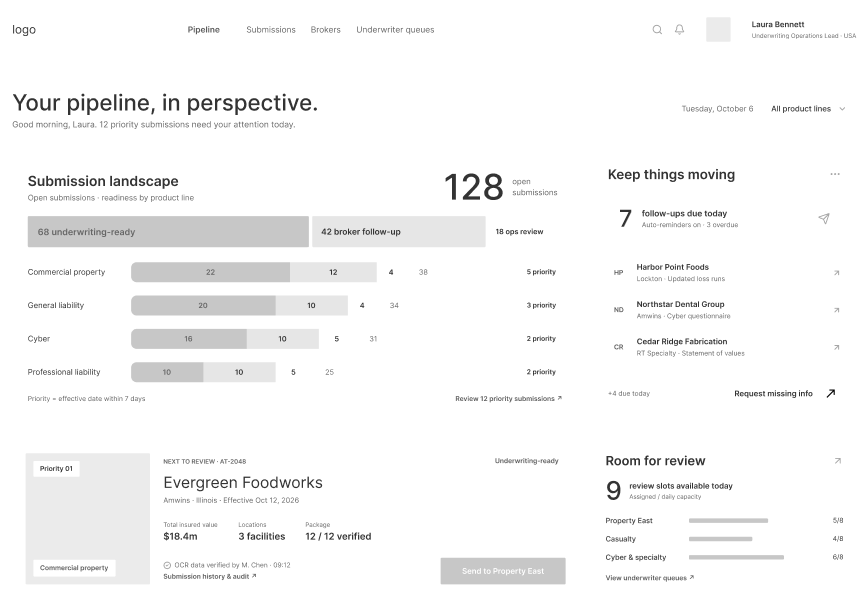
Testing broker intake, document review, risk-data validation, underwriting queues, and pipeline interactions before interface development.
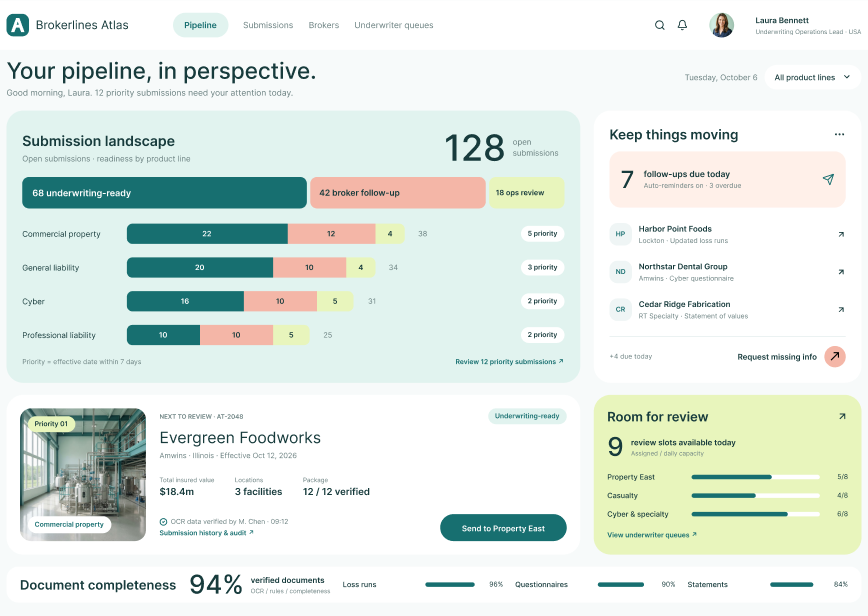
Creating role-based views that make submission readiness, risk information, priorities, and pending actions easier to assess.

React
Powered broker-facing submission workflows and internal underwriting interfaces, including structured questionnaires, document review, submission status, underwriting queues, pending actions, and pipeline dashboards.

TypeScript
Added stronger typing across front-end and application logic, supporting more predictable handling of structured submission, broker, and risk data.

Node.js
Supported server-side workflow logic, submission processing, validation, task routing, and integrations with existing insurance systems.

PostgreSQL
Stored structured submission, broker, risk, workflow, and operational data used across the platform.

AWS
Provided the cloud infrastructure supporting application deployment and platform operations.
REST API
Connected Brokerlines Atlas with CRM, policy administration, and document management systems, allowing broker data, submission information, policy context, and supporting documents to move across the underwriting workflow.
OCR and AI
Supported document classification, extraction of key risk parameters, and preparation of structured submission data for completeness and validation checks. AI-assisted functions reduced manual document review while underwriters retained control over pricing, eligibility, and approval decisions.
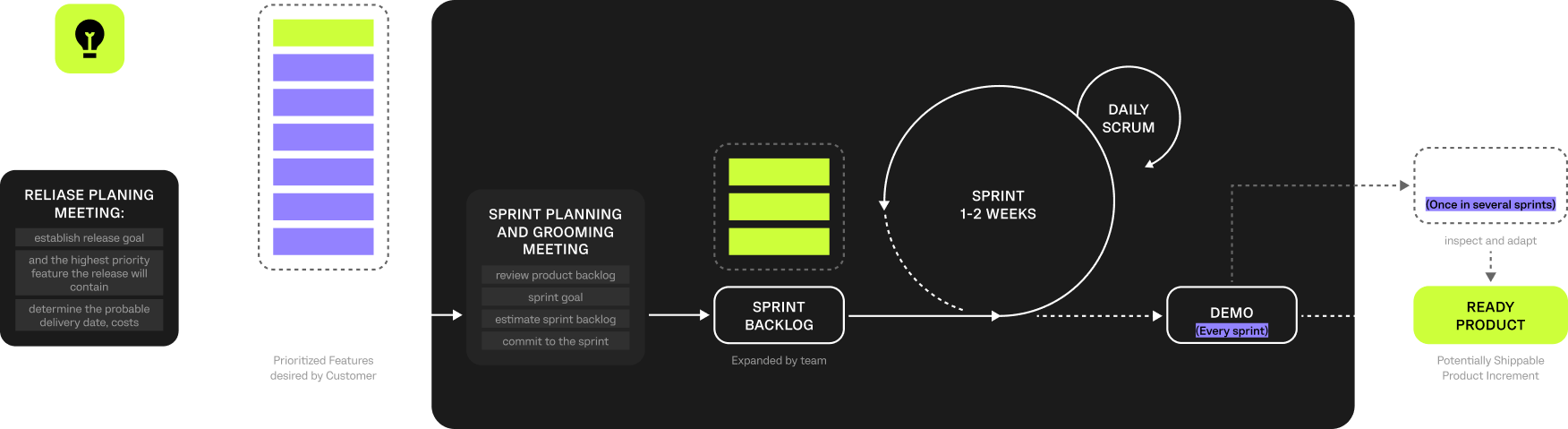
Computools used a Scrum-based delivery model with two-week iterations and regular validation by underwriting, broker operations, product, compliance, and technical stakeholders. Each iteration focused on a specific part of the submission lifecycle, including broker intake, document processing, risk data validation, follow-up tasks, underwriting queues, integrations, or pipeline reporting. Changes were reviewed against representative submission scenarios before subsequent development.
AI-assisted functions were validated separately for document classification, risk-data extraction, and information validation. Integration, access-control, override, and audit requirements were tested throughout development to reduce release risks across connected insurance systems.
Before Brokerlines Atlas, a submission could look complete at first glance and still be missing the one document or risk detail an underwriter needed. That meant extra emails, manual checks, and a lot of time spent getting the file ready. Now the team can see what is missing much earlier, and underwriters start with a much cleaner submission.




Computools | 341 Raven Cir, Camden Wyoming, Delaware 19934, US